Before the Frost: Five Warming Things to Do With the Last Plums
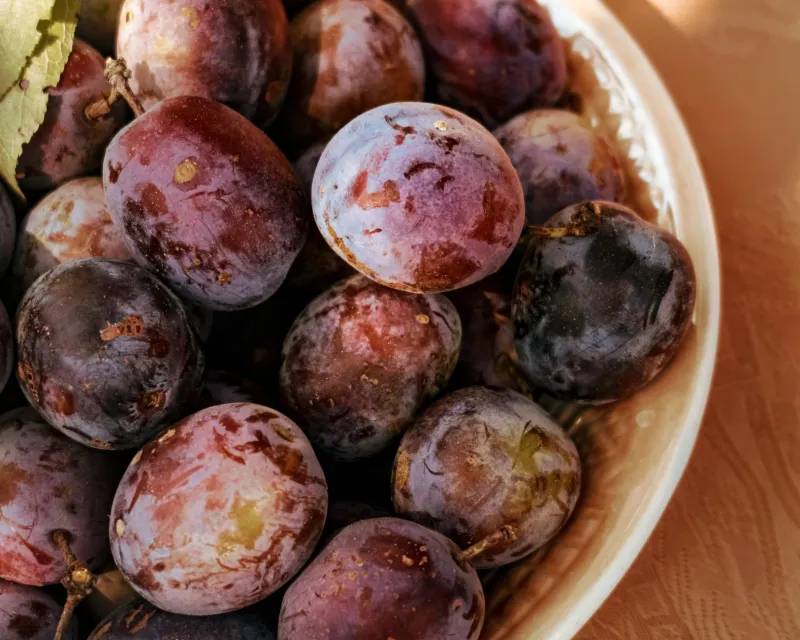
At Clingstone, we are not quite ready to surrender the stone fruit season. The first frost warning of autumn 2026 has already appeared on the weather app, the supermarkets have built their clementine pyramids, and yet the last British damsons and late plums are still turning up at farmers' markets, slightly dusty and deeply coloured. This is the tail end of the season, and it deserves better than a sad bowl on the counter.
Late plums are not a consolation prize
Late-season fruit can be firmer and sharper than the perfumed peaches of July. That is not a flaw. It is a hint: pair these plums with sugar, spice and heat, and they will reward you. Imported plums from Spain and Italy are still around in early November, and stored British fruit can be excellent if you know what you are looking at. Damsons, those small, inky, intensely tart relatives, are made for slow cooking. The aim is simple comfort: poached fruit, crumbles, a sharp-sweet sauce for roast pork, a cake that improves by Tuesday.
How to choose fruit that is worth carrying home
Start with your nose. A ripe plum smells sweet and slightly floral at the stem end. The skin should give a little under your thumb, not collapse. Look for the natural bloom, that dusty white coating on the skin; it is a sign the fruit has been handled gently. Avoid fruit with wrinkled skin or damp patches, and do not be put off by a slightly soft plum if you plan to cook it that day. If the plums are hard, leave them in a paper bag with a banana for a day or two. Wash them only when you are ready to use them. At the market, ask which variety you are buying; a Victoria plum and a damson behave very differently in a pan.
1. Spiced poached plums with bay and black pepper
This is the simplest way to make late fruit taste like an occasion. Put 150g caster sugar, 300ml water, a cinnamon stick, two star anise, a bay leaf, a strip of orange zest and a few black peppercorns in a saucepan. Heat gently until the sugar dissolves, then simmer for five minutes. Halve and stone 750g plums or damsons and add them to the syrup. Poach very gently for eight to ten minutes, until the fruit is tender but still holding its shape. Damsons will need a little more sugar; taste the syrup and adjust. Serve warm with yoghurt, cold with porridge, or spooned over vanilla ice cream. The syrup is worth keeping in a jar in the fridge.
2. Plum and ginger crumble
A crumble is the correct response to a cold November evening. Halve and stone 700g plums and put them in a buttered dish with two tablespoons of sugar and a thumb of fresh ginger, grated. For the topping, rub 100g cold butter into 150g plain flour until it looks like breadcrumbs, then stir in 60g oats, 80g light brown sugar and a pinch of salt. Scatter over the fruit and bake at 180C for 35 to 40 minutes, until the juices bubble at the edges and the top is golden. Let it stand for ten minutes before serving. Custard is not optional.
3. Savoury plum sauce for roast meats
This is the recipe that converts people who think they do not like cooked fruit. Roughly chop 500g plums, one onion and two garlic cloves. Put them in a pan with 100ml red wine vinegar, 80g brown sugar, two tablespoons soy sauce, a star anise and a pinch of chilli flakes. Simmer gently for 30 minutes, until everything is soft and the liquid has reduced. Fish out the star anise, blitz the sauce until smooth, and season to taste. It is excellent with roast pork, lamb or duck, and keeps in the fridge for a week. Think of it as a fruity brown sauce with a bit of attitude.
4. Plum and almond cake
This is the kind of cake that sits under a tea towel and gets better by Tuesday. Beat 200g soft butter with 200g caster sugar until pale, then add three eggs one at a time, beating well. Fold in 100g ground almonds, 100g plain flour, a teaspoon of baking powder and a pinch of salt. Spoon into a lined 20cm tin and arrange 400g halved and stoned plums on top, cut side up. Bake at 180C for 45 to 50 minutes, covering with foil if it browns too quickly. Cool in the tin. The plums sink and soften, and the edges go crisp.
5. Roast plums with honey and thyme
For fruit that is still a little firm, roasting is the answer. Halve and stone 500g plums and put them in a roasting tin. Drizzle with two tablespoons of honey, dot with a little butter, add a few sprigs of thyme and a pinch of salt. Roast at 200C for 15 to 20 minutes, until the fruit slumps and the juices run. Serve on porridge, on ricotta toast, or with ice cream. It is also a very good breakfast if you are the sort of person who plans ahead.
When the frost finally arrives, you will be glad of a jar of poached plums in the fridge and a sauce in the cupboard. The season is ending, but the cooking is just getting started.