Orchard Experiments: The Growers Rewriting Britain’s Stone Fruit Map
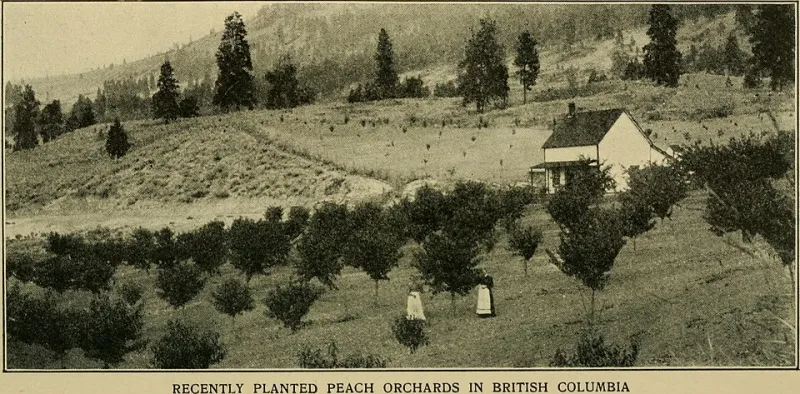
Photo: Internet Archive Book Images, No restrictions, via Wikimedia Commons
The British peach has always had a whiff of romance about it. You picture a warm brick wall, a fan-trained tree, a gardener with a straw hat and a single perfect fruit saved for the kitchen table. For most of us, that is exactly where it has stayed: a picture. But in 2026, the picture is becoming a crop. Not a huge one. Not a cheap one. But a real one, in orchards and polytunnels from Kent to the Welsh borders.
I spent part of this season talking to growers who are betting on stone fruit as the UK climate shifts. Some are cautiously optimistic. Some are exhausted. All of them are experimenting. The new British peach belt is not a single region yet. It is a scatter of sites, varieties and microclimates, held together by the same question: can we make a peach that actually ripens here, tastes good and makes financial sense?
The new peach belt
Kent and Sussex are the obvious starting points. The south-east already has the warmth, the fruit-growing infrastructure and the packhouses. In the past, British peaches were a walled-garden delicacy, grown for country houses and sold in tiny quantities. Now, some commercial growers are planting them under polytunnels, where rain can be kept off the fruit and the season nudged forward.
The Welsh borders are less obvious, which is part of the appeal. A sheltered site with good drainage and a sunny aspect can produce remarkable fruit. One grower I spoke to described the border valleys as a series of little microclimates, each one slightly different. That matters for stone fruit, which dislikes wet roots, late frost and cold wind. A wall, a hedge or a slope can make the difference between a crop and a disappointment.
What actually ripens here
Not every peach likes Britain. Leaf curl is a constant threat in wet springs, and varieties that shrug it off are worth their weight in gold. Growers talk about 'Avalon Pride' for its resistance, 'Peregrine' for flavour and reliability, and older varieties that have survived in walled gardens for generations. Nectarines are trickier. Apricots are trickier still, though 'Tomcot' and 'Flavourcot' come up again and again.
The season is short. Depending on the site, UK peaches and nectarines tend to arrive from late July into September. Apricots sit in a narrower window, often late July to late August. The fruit is rarely uniform. It can be smaller than the imports, sometimes scruffier, and it does not always travel well. But the best samples have a perfume and a sweetness that make you understand why growers keep trying.
Why wall-trained and polytunnel fruit tastes different
A wall is not just a pretty backdrop. It stores heat during the day and releases it at night, which helps fruit ripen in a marginal climate. It also shelters the tree from wind and rain. Polytunnels do a similar job on a larger scale. They keep the fruit dry, reduce disease pressure and push the harvest window earlier. The trade-off is cost, ventilation and the constant need to manage humidity.
Growers say the difference is in the skin and the aroma. British fruit is often picked closer to full ripeness because it does not have to survive a long journey. That means more scent, softer flesh and a shorter shelf life. It can also mean less water and more concentration. The romance is real. So is the fragility.
The grower view: price, yield and weather
Here is the clear-eyed bit. British stone fruit is expensive to grow. Yields are lower than in southern Europe. Labour is costly. Polytunnels and wall training are not cheap. A late frost can wipe out a season. A wet summer can bring disease. The 2022 heatwave taught growers that heat is not automatically a gift; sunburn and water stress are real problems, too.
This year's season was a reminder of how variable the weather can be. Growers I spoke to were cautiously pleased with quality in some sites and frustrated by uneven ripening in others. The best fruit was beautiful. The worst was a lesson. Nobody is claiming Britain will become a major peach exporter. The aim is smaller and more interesting: a premium local crop for farm shops, markets, restaurants and shoppers who want to taste something that was picked nearby.
That means price. Expect to pay more for British peaches than for imports. You are paying for flavour, seasonality and a very short chain. You are also paying for risk. A grower who loses a crop to frost does not get that money back.
How to spot British stone fruit in 2026
Start with the label. Look for 'grown in the UK' or a named British farm, not just a Union Jack on a punnet of imported fruit. Farm shops and farmers' markets are the best bet, but some greengrocers now stock British peaches in season. Ask. If the person behind the counter knows the variety and the grower, you are in the right place.
Expect smaller fruit. British peaches are not bred to be uniform supermarket specimens. Look for names on the box, such as Peregrine or Avalon Pride. Smell the fruit. A ripe peach should smell sweet at the stem. And do not expect a long shelf life. If it is soft and fragrant, eat it soon. That is the point.
The romance and the reality
There is something quietly thrilling about a British peach. It feels like a small victory over the weather. But the story is not just romance. It is about growers testing varieties, spending money on shelter and trying to build a market for fruit that is delicious but delicate.
At Clingstone, we are biased. We think stone fruit deserves this kind of attention. The new British peach belt may never be large, but it is worth watching. Buy a punnet when you see one. Ask who grew it. Eat it over the sink. That is how a local crop becomes more than an experiment.